


Obesity Society Innovation Award honors Zhang for discoveries of new food intake, energy mechanisms

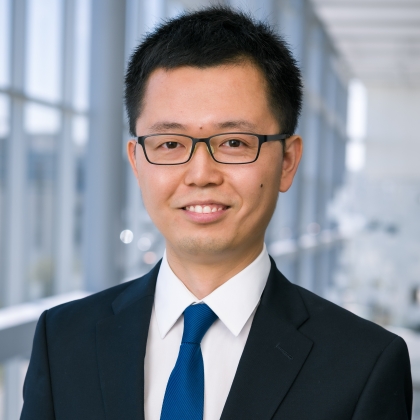
By studying the biological mechanisms that control appetite, weight, and metabolism, the Zhang Lab moves backward to push forward.
“We start with unusual variations in these traits, then work backward to identify the responsible genes and understand how they work,” said Zhao Zhang, Ph.D., Associate Professor in the Center for the Genetics of Host Defense and of Internal Medicine. “This approach, called forward genetics, helps us uncover mechanisms we might not have thought to look for.”
For his progress and potential, The Obesity Society, the leading professional organization focused on obesity science, treatment, and prevention, has selected Dr. Zhang for its Jules Hirsch Innovation Award, which recognizes early-career investigators whose novel work will significantly impact the field.
“Many of our projects begin with an observation that we cannot readily explain. This recognition encourages us to keep asking questions and following the biology, even when it takes us in an unexpected direction,” Dr. Zhang said.
A major focus for Dr. Zhang is primary cilia, tiny antenna-like structures on brain cells. His team found that a protein called GPR45 helps bring an essential signaling protein into these structures, enabling signals that limit food intake to work properly. The lab’s studies of another protein, GPR75, revealed a different ciliary pathway that promotes feeding.
“These findings show how events within a very small part of a brain cell can have a large effect on appetite and body weight,” he said.
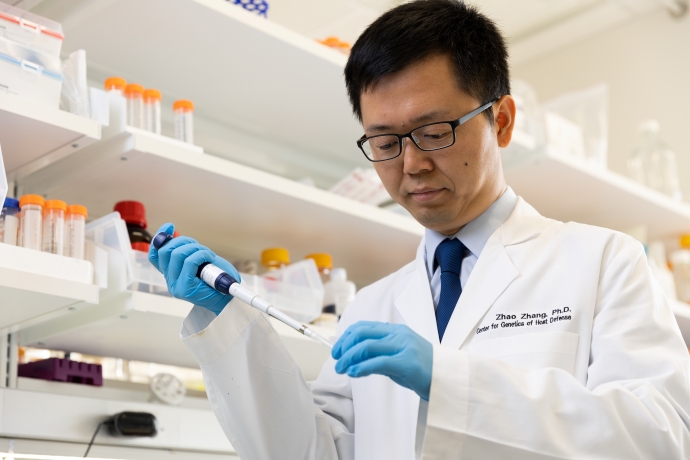
The researchers also discovered that a mutation in the OVOL2 gene causes mice to develop obesity without eating more. The mutation disrupts the development of brown fat, which burns energy to produce heat, Dr. Zhang explained.
“Together, these studies reveal new mechanisms controlling both food intake and energy use, with potential implications for treating obesity,” he said.
Next steps are to understand these pathways in greater detail.
“We are particularly interested in finding ways to modify the signaling involving GPR45 and GPR75 to improve appetite and body-weight regulation. The longer-term goal is to translate these mechanistic discoveries into new treatment approaches for people with obesity,” Dr. Zhang said.
The award will be presented at ObesityWeek 2026 in November in National Harbor, Maryland, where Dr. Zhang will give the Jules Hirsch Innovation Award Lecture. His presentation is titled “Decoding Obesity by Forward Genetics: Ciliary GPCR Control of Feeding and Body Weight.”
“I hope attendees come away with a greater appreciation of how signals organized within a tiny part of a brain cell can have a major effect on appetite and body weight,” he said. “I also hope our work illustrates the value of following unexpected genetic findings, which can lead us to mechanisms and potential treatment targets that we would not have predicted.”
Dr. Zhang earned his Ph.D. in developmental biology from the Chinese Academy of Sciences and completed his postdoctoral training with Nobel Laureate Bruce Beutler, M.D., Director of UTSW’s Center for the Genetics of Host Defense and Professor of Immunology and Internal Medicine. He established his independent laboratory at UTSW in 2020 with support from a National Institutes of Health (NIH) Pathway to Independence Award (K99/R00).
Dr. Zhang received a 2023 Haberecht Wildhare-Idea Research Grant from the UTSW Graduate School of Biomedical Sciences and was the inaugural recipient of the American Heart Association’s Jack Sarver Prize in Basic Science in 2025.