
News Highlights - November 3 2026
Kudos
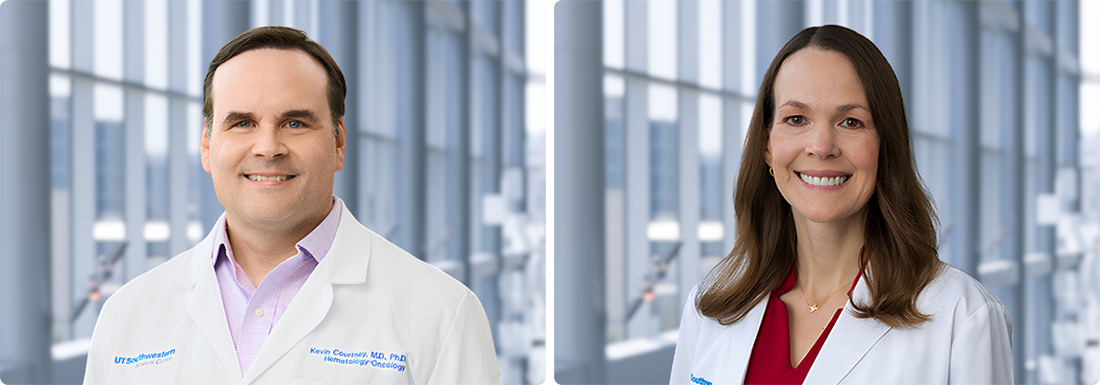
Courtney, Cole to Receive Leaders in Clinical Excellence Awards
Kevin Courtney, M.D., Ph.D., and Suzanne Cole, M.D., will be recognized this week as recipients of UT Southwestern’s Leaders in Clinical Excellence, honoring their contributions to patient care, clinical innovation, and program development.
Dr. Courtney, a Professor in the Division of Hematology and Oncology, will receive the Patricia and William L. Watson Jr., M.D. Award for Excellence in Clinical Medicine, UT Southwestern’s highest honor for clinical care. The award recognizes outstanding patient care, leadership in advancing clinical innovation, and work that has had a significant impact on patients, students, trainees, and colleagues. Read his profile in Center Times Plus.
Dr. Cole, an Associate Professor in the Division of Hematology and Oncology and Regional Medical Director of the Community Oncology Program in the Simmons Comprehensive Cancer Center, is part of the team receiving the Program Development Award for the center’s Community Oncology Program. The honor recognizes collaborative programs that strengthen patient care through innovation and sustained teamwork. The Community Oncology Program has helped extend access to cancer care and clinical trials closer to where patients live. Read about the program in Center Times Plus.
The Leaders in Clinical Excellence Awards ceremony begins at 4:30 p.m. on Wednesday, Nov. 4, in the Tom and Lula Gooch Auditorium, with a reception afterward on McDermott Plaza. Faculty and staff are invited to attend in person or virtually. ■
Dr. Courtney holds the Micky and Vinita Pant Chair in Bladder Cancer, in Honor of Ganesh V. Raj, M.D., Ph.D.

David Khan, M.D., a Professor in the Division of Allergy and Immunology, has been named the next Executive Vice President of the American Academy of Allergy, Asthma & Immunology (AAAAI), the leading professional organization for specialists in the field. He will assume the role in January 2027 and serve concurrently with the current Executive Vice President through the conclusion of the 2027 AAAAI Annual Meeting.
Dr. Khan has held numerous leadership positions within the AAAAI, including serving as its President from 2022 to 2023. He previously chaired the organization’s Program Directors Section; Food Allergy, Anaphylaxis, Dermatology and Drug Allergy Section; and In-Training Examination Committee. He also served for 16 years on the Joint Task Force on Practice Parameters, chaired the AAAAI Foundation Council from 2023 to 2024, and currently serves as an Associate Editor of The Journal of Allergy and Clinical Immunology: In Practice.
“The opportunity to serve as Executive Vice President offers a wonderful continuation of that journey,” Dr. Khan said. “One of the things I value most about the AAAAI is working with an exceptional group of people, including the Board of Directors and dedicated staff, who share a common purpose.”
As Executive Vice President, Dr. Khan will help oversee the organization’s operations and respond to issues affecting the academy and the specialty, extending a record of national leadership devoted to advancing allergy and immunology. ■
Welcome to the Department
The Department of Internal Medicine saw the addition of the following faculty and staff in the month of October:
- MaKenna Brown – Postdoctoral Researcher, Endocrinology
- Natasha Dass – Assistant Professor, Combined Internal Medicine & Pediatrics
- Christen Dillard – Assistant Professor, Hematology & Oncology
- Michael Dinh – Assistant Professor, General Internal Medicine
- Katherine Dupas – Clinical Assistant Professor, Hospital Medicine
- Shanikumar Goyani – Postdoctoral Researcher, Cardiology
- Vladimer Kitiashvili – Clinical Assistant Professor, Hospital Medicine
- Sri Ledalla – Research Technician II, Hematology & Oncology
- Jordan Mattke – Postdoctoral Researcher, Digestive & Liver Diseases
- Mia Beatriz Ramos Mercado – Population Research Project Assistant I, Infectious Diseases & Geographic Medicine
- Natia Murvelashvili – Assistant Professor, Endocrinology
- Jay Naik – Clinical Assistant Professor, Hospital Medicine
- Viral Patel – Assistant Professor, Hematology & Oncology
- Taylor Rossiter – Graduate Student Researcher, Infectious Diseases & Geographic Medicine
- Sanay Sheth – Clinical Research Assistant I, Digestive & Liver Diseases
- Alisha Shrestha – Research Technician II, Digestive & Liver Diseases
- Angelica Toro-Cora – Postdoctoral Researcher, Cardiology
- FNU Vaishali – Postdoctoral Researcher, Nephrology
- Allison Wang – Assistant Professor, Digestive & Liver Diseases
Staff Members Take on New Roles
We congratulate the following staff members who recently took on new positions within the Department:
- Jennifer Araiza – Program Coordinator, Hematology & Oncology
- Antonio Atkins – GME Program Coordinator III, Infectious Diseases & Geographic Medicine
- Tonya Crews – GME Program Coordinator III, Instruction Administration
- Philong Do – Clinical Research Coordinator I, Pulmonary & Critical Care Medicine
- Natalie Farran – Sr. Financial Analyst, Department Administration
- Zahria Griggs – Community Outreach Specialist, Community Prevention & Intervention Unit
- Nicole Herleman – Physician Assistant, Pulmonary & Critical Care Medicine
- Ayeeshik Kole – Assistant Professor, Cardiology
- Samantha Mireles – Program Coordinator, Hypothalamic Research
- Crystal Neugin – Clinical Research Coordinator I, Pulmonary & Critical Care Medicine
- Erin Palmer – Physician Assistant, Pulmonary & Critical Care Medicine
- Jonathan Porter – GME Program Coordinator II, Instruction Administration
- Langdon Stone – Assistant Professor, Nephrology
- Cydney Sutherland – Project Manager, Instruction Administration
- Alexandra Sykes – Assistant Professor, Cardiology
- Yolanda Thomas – Clinical Research Coordinator I, Cardiology
- Terri Visnick-Chang – Clinical Research Coordinator II, Pulmonary & Critical Care Medicine
- Jasmine Weiland – GME Program Coordinator II, Instruction Administration
- Trip Winans – Lab Helper, Hypothalamic Research
Research Report

Greenberg Receives $4M NIH Grant to Advance Rapid Detection of Antibiotic Resistance
David Greenberg, M.D., a Professor in the Division of Infectious Diseases and Geographic Medicine, has received a $4 million multi-PI R01 grant from the National Institutes of Health to develop machine-learning tools that could help physicians identify antibiotic-resistant infections more rapidly and select effective treatments sooner.
Dr. Greenberg is leading the multidisciplinary project with Xiaowei Zhan, Ph.D., and Lin Xu, Ph.D., of the Quantitative Biomedical Research Center. The researchers aim to develop algorithms capable of predicting antibiotic resistance from whole-genome sequences of major human pathogens. By combining these algorithms with real-time sequencing technologies, the team hopes to determine whether resistance can be detected reliably and more quickly than with current diagnostic methods.
“We are trying to move bacterial and fungal diagnostics into the genomics era,” Dr. Greenberg said. “Traditionally, laboratories must culture an organism, identify it, and then determine which antibiotics it is susceptible to or resistant to, a process that can take several days.”
A faster approach could have direct implications for patient care. The researchers ultimately hope to create a platform that identifies the strain causing an infection and predicts its resistance profile quickly enough to help clinicians choose the appropriate drug. Dr. Greenberg said the team plans to test the approach in the clinical microbiology laboratory over the next several years.
The project builds on years of research and previous NIH funding and draws on the Texas Infectious Diseases Biorepository, which Dr. Greenberg directs, as critical infrastructure for the studies. The long-term objective is to replace time-intensive culture-based testing with genomic approaches that can deliver clinically useful information sooner.
“More rapid diagnostic tests are needed to identify drug-resistant infections in patients,” Dr. Greenberg said. “We hope to show that these algorithms, when merged with real-time sequencing platforms, can reliably detect resistance and do so more quickly than current standard-of-care diagnostic tests.” ■
Dr. Greenberg is a Distinguished Teaching Professor.
Education & Training
UT-StARR Helps Advance Research Careers
Residents interested in careers in cardiovascular, pulmonary, or hematology research are encouraged to apply for the UT-StARR program, a residency research program funded by the National Heart, Lung, and Blood Institute. Designed to help physician-scientists launch research careers during residency, the program provides protected research time, faculty mentorship, structured research training, and professional development support.
The program supports up to two Internal Medicine or Pediatrics residents annually and allows participants to dedicate one to two years to basic, translational, or clinical research focused on heart, lung, or blood disorders. Beginning July 1, 2027, selected residents will spend 80% of their time conducting research while maintaining limited clinical responsibilities or pursuing additional training opportunities.
UT-StARR provides salary and fringe support, research and training funds, travel funding, mentorship from a faculty-led committee, and opportunities to connect with investigators and research trainees across UT Southwestern.
Applicants must be residents in good standing and meet NIH training grant eligibility requirements. Applications are due Dec. 15, 2026, and selected residents will begin the program in July 2027. ■